Looking for the best software for event photographers in 2026? Compare Cam-Shot AI, FotoOwl, Kwikpic, Samaro, Kamero and CamTom across AI face recognition, QR photo sharing, event gallery software, photo selling and white-label branding.
1. The State of Event Photography in 2026
If you are searching for the best software for event photographers in 2026 — or the best event photography software 2026 shortlist for your studio — this guide is built for that commercial-investigation brief. A single Indian wedding can generate 8,000 to 15,000 photographs across three days of ceremonies. A corporate conference produces thousands more, spread across keynote stages, networking lounges and photo booths. For teams evaluating Cam-Shot for corporate events, branded galleries and attendee face search sit alongside the same delivery pipeline. Education teams can review school and college event photo sharing for QR access, selfie search and controlled galleries. For decades, the hardest part of event photography wasn't capturing those images — it was getting the right image to the right person, quickly enough for it to still matter.
That bottleneck has now become the defining competitive battleground of the industry. Guests who once waited weeks for a Google Drive link (a weak Google Drive alternative for photographers) now expect instant photo delivery for events — to see themselves on stage before they've left the venue. Corporate clients measure photographers not just on image quality but on engagement metrics and gallery analytics: how many attendees opened the guest gallery, downloaded photos, and shared branded images to social media. Wedding couples compare photographers on delivery speed as often as on portfolio style — and increasingly ask for a wedding gallery software or wedding photo sharing app experience, not a folder dump.
The response has been a wave of specialized platforms — event photography software, event gallery software and AI photo sharing platforms — that automate everything after the shutter click. India has become one of the most active markets in this category, home to platforms like Cam-Shot AI, FotoOwl, Kwikpic, Samaro, Kamero and CamTom (the common FotoOwl vs Kwikpic vs Samaro shortlist, plus Cam-Shot / Kamero / CamTom). Each approaches the same problem from a different angle: delivery speed, client proofing, WhatsApp Business messaging, camera-to-cloud photo upload, or full business infrastructure for event photographers, wedding photographers, photography studios, event management companies and corporate event agencies.
This buying guide compares those six platforms objectively — a practical Cam-Shot AI alternative comparison for studios evaluating event photographer tools — explains the technology behind them, and gives you a framework for choosing the one that fits how you actually work.
2. Why Event Photographers Need Dedicated Software
Every studio starts the same way: shoot the event, cull in Lightroom, dump finals into Google Drive or WeTransfer, send the link, and hope. That workflow is exactly why photographers outgrow generic storage and look for a real Google Drive alternative for photographers — photo delivery software and a photo sharing app for photographers that actually matches event scale. It works — until it quietly costs you three things.
Time you can't bill for
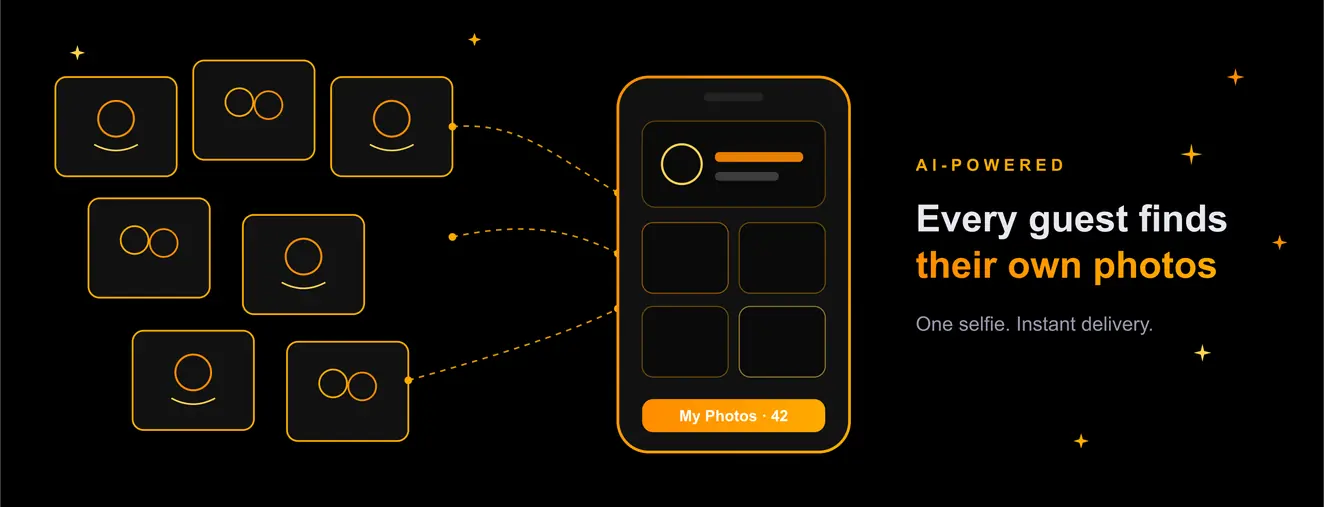
Manually sorting thousands of photos by person, family or department is unpaid labor. Studios report spending hours per event answering the same message: "Can you send the photos I'm in?" AI face recognition for photographers and face recognition photo delivery answer that with selfie search and a personal photo gallery for every guest, at once — after face indexing on bulk photo upload.
A brand you can't see
A Drive folder carries Google's brand, not yours. There's no logo, no watermarking, no portfolio link, no enquiry form — no path from an impressed wedding guest to your next booking. Dedicated platforms wrap every gallery in branded galleries and your identity, and the best ones give you a studio subdomain guests can discover on their own.
Revenue you never collect
Generic storage has no checkout. If a conference attendee wants a high-resolution print file, there's no built-in way to sell event photos online. A photo selling platform for photographers turns every gallery into a storefront — photo monetization with photo download permissions, Razorpay checkout, GST invoicing and payouts — letting you monetize the long tail weeks after the booking fee cleared.
3. The Modern Event Photography Workflow
Modern platforms compress what used to be a two-week delivery cycle into a pipeline measured in minutes. Here is the workflow that the best software in this category now automates end to end:
Notice what's absent from that diagram: manual sorting, manual tagging, manual "which photos am I in?" replies, and manual invoicing for extra photos. The photographer's active work ends at upload. Everything downstream — processing, face matching, delivery, engagement and even commerce — runs on autopilot. That is the core promise of this software category, and the six platforms below differ mainly in how much of this pipeline they cover and how well they execute each stage.
4. The AI Revolution in Event Photography
Three AI capabilities have moved from novelty to table stakes in the last few years, and they are reshaping what clients expect from every studio:
Recognition: photos that find their people
Face recognition is the category's founding technology. Instead of a guest searching for photos, the photos search for the guest. Modern engines index thousands of faces per event and match a single selfie against them in seconds — under stage lighting, in crowds, and at odd angles.
Curation: AI that picks the best shots
The newer frontier is quality intelligence. Some platforms now score every image on sharpness, brightness, expressions and composition, then automatically assemble highlight reels — the best 30 photos of an event, the best photos of you, or a "one year ago today" memory collection. Cam-Shot's highlights engine, for example, analyzes each uploaded image and generates event-wide, per-collection, and personal highlight sets on a rolling schedule, plus AI-titled highlight videos with music. Samaro and FotoOwl approach curation from other angles — AI-assisted editing profiles and auto-generated personalized guest reels, respectively, per their published feature pages.
Generation: AI that does the writing
Large language models are quietly entering the workflow too: auto-generated gallery titles and descriptions, AI-drafted quotations and service suggestions, and share-ready captions. These features don't photograph anything — they remove the administrative drag around the photography.
The practical takeaway: when you evaluate platforms in 2026, you're no longer just buying storage and a gallery skin. You're choosing an AI stack — and the differences between stacks are now large enough to change your delivery speed, your client experience and your revenue.
5. How AI Face Recognition Works for Event Photos
AI face recognition for photographers sounds like magic; it's actually a well-understood, four-stage pipeline for face recognition photo delivery. Understanding it helps you ask vendors the right questions about accuracy, speed and privacy — including face indexing, selfie search and how a personal photo gallery is built.
Under the hood, platforms differ in the recognition engines they use and how they operate them. Cam-Shot runs on Amazon Rekognition with a separate face collection per event, which matters for both accuracy (smaller search space) and privacy (no cross-event matching). Kwikpic advertises a 99.9% accuracy figure for its proprietary matching; Kamero and FotoOwl describe automatic indexing on upload with selfie-based retrieval. Vendor accuracy claims are hard to verify independently, so the honest evaluation method is simple: run the same real event through two platforms during a trial and count the misses.
Questions worth asking any vendor: Is face data isolated per event? Can guests opt out? Is the original selfie stored, and for how long? Does matching survive low light, motion blur and partial occlusion? How are children's faces handled? A serious platform will have crisp answers. Read how Cam-Shot approaches face recognition and privacy →
6. QR Photo Sharing & Instant Gallery Delivery
QR photo sharing and QR code photo sharing for events solve distribution once face recognition has solved discovery. An event QR code on a standee collapses the gap between "photo taken" and "photo in the guest's hands" to under a minute — the core of instant photo delivery for events.
Execution details separate the platforms here. Look for: styled, branded QR codes (a plain black-and-white square wastes a sponsorship surface); no-app-required web galleries so older relatives aren't stuck at an install screen; access controls like event PINs, guest whitelists and per-event privacy modes; and deep links that survive WhatsApp forwarding. Cam-Shot generates event and studio QR codes with PIN and whitelist gating built in; Kamero centers its flow on branded QR registration; Samaro leans on WhatsApp links as the primary channel alongside QR. All are valid approaches — pick the one matching how your guests actually behave. See Cam-Shot's QR sharing in action →
7. The Complete Buying Guide: 10 Criteria That Matter
Feature lists blur together fast. These are the ten criteria that actually predict whether a platform will still make you happy twelve months in — use them as your evaluation scorecard.
The three questions behind the scorecard
1. Where does your revenue actually come from? If bookings are everything, weight branding and portfolio features. If you shoot marathons, conferences or school events, weight photo selling and analytics — the gallery itself is the product.
2. What does your delivery volume look like? A studio delivering 40+ events a year on a per-event plan often pays more than a flat subscription would cost. Model a realistic year on each vendor's pricing page before deciding. Watch for hidden constraints third-party reviewers flag on some platforms: per-photo credits, resolution caps, guest limits or one-time storage reuse policies.
3. Who has to succeed with it? Not you — your least technical guest and your least technical second shooter. A platform that requires guests to install an app, or teammates to learn an FTP client, imposes a hidden adoption tax on every single event.
8. The Contenders: 6 Platforms at a Glance
All six platforms below offer AI face recognition and gallery delivery — that's the entry ticket. What differs is philosophy: each was built around a different center of gravity.
Cam-Shot AI — the end-to-end business platform. Face recognition, AI highlights and memory collections, in-gallery photo selling with per-image and tiered pricing, AI-assisted quotations, branded studio subdomains with portfolio and enquiry capture, collaborator permissions, and guest engagement (reactions, comments, TV casting). Built for studios that want one system for delivery, brand and revenue.
FotoOwl AI — the delivery and selection specialist. Face recognition galleries via a single link, client proofing with likes and comments, FTP camera-to-cloud ("Beam"), AI-generated personalized guest reels, photo selling with gallery-level pricing (10% commission per its published terms), WhatsApp notifications, social scheduling and a website builder. A generous free "Creator Pass" tier makes it easy to start.
Kwikpic — the high-speed sharing veteran. Claims 99.9% face-match accuracy and one of the fastest bulk uploaders in the category, with branding and watermarking, portfolio websites, registration analytics for lead capture, album selection, monetization options and white-label website/app services. Pricing is credit/plan-based; third-party reviews note per-photo resolution tiers worth checking against your quality needs.
Samaro — the engagement-first "event OS." WhatsApp bot for both delivering photos and collecting guest-shot media, digital invites with RSVP, Netflix-style video galleries, AI editing profiles, face recognition and camera-to-cloud on its roadmap pages. Strongest where guest participation and WhatsApp-native behavior matter; plans are event-based bundles, so verify guest and media caps against your event sizes.
Kamero — the white-label app builder. Face recognition, instant delivery, guest uploads, Kam-Sync FTP camera-to-cloud (up to 10 cameras), photo shortlisting, watermarking and pay-per-use photo packs (100–10,000 photos per event). Its signature offer: fully branded iOS/Android apps built for studios, listed from ₹49,999 — compelling if "your own app" is the goal.
CamTom — the selection and CRM layer on Google Drive. Online photo selection replacing studio visits, AI face-access guest mode, QR codes, watermarking, automatic RAW sorting against client selections, and customer/order management — with storage remaining in the photographer's own Google Drive. A different category of tool: strongest for album-selection workflows, lighter on delivery-at-scale features.
9. Feature-by-Feature Comparison
The matrix below reflects publicly available vendor documentation and product pages as of July 2026. Features change quickly in this category — treat this as a starting map and verify anything decision-critical directly with the vendor.
10. Platform Deep Dives
Cam-Shot AI End-to-end platform
Cam-Shot's thesis is that delivery, brand and revenue shouldn't live in three different tools. The delivery layer is web-first (guests scan a QR, no app install) with per-event face isolation on AWS Rekognition. On top of it sits an AI highlights engine that scores every image and auto-generates event-wide, per-collection and personal highlight sets — plus memory collections ("one year ago today", "photos with…") and AI-titled highlight videos with music. The media store supports per-image and tiered pricing with Razorpay checkout, GST handling, invoices and studio payouts. The brand layer gives each studio a branded subdomain with portfolio, SEO settings and an enquiry form that turns impressed guests into leads, and an AI quotation builder closes them. Collaborator permissions, engagement features and TV casting round out the guest experience. Pricing spans INR and USD plans across four billing cycles, with USD plans from $20/month. The honest trade-off: it's a broader system than a pure delivery tool, so studios that only want link sharing may not use everything they're paying for.
FotoOwl AI Delivery specialist
FotoOwl concentrates on getting photos from camera to guest with minimal friction: single-link face recognition galleries, Beam FTP camera-to-cloud, proofing with likes and comments, and WhatsApp notifications. Its AI personalized reels — an auto-generated highlight video per guest — is a genuinely distinctive engagement feature. Photo selling works at gallery-level pricing (one price for all images in a gallery, 10% commission including gateway charges, per its published terms), which is simpler but less flexible than per-image pricing. The free Creator Pass (10,000 photos/year) is one of the most generous entry offers in the category; full white-labeling sits in paid tiers.
Kwikpic Speed & scale veteran
One of the category's most established names, Kwikpic reports having powered 500,000+ events. Its strengths are raw throughput (its uploader claim: 1,000 photos in ~5 minutes), a claimed 99.9% face-match rate, and business tooling — registration analytics that double as lead capture, portfolio websites, watermarking and white-label services. Third-party comparisons flag things to verify for your use case: credit-based pricing with resolution tiers (default ~1MB, high-res ~2MB at higher credit cost) and storage reuse limits. If your priority is fast, branded delivery with lead data, it remains a serious contender.
Samaro WhatsApp-first engagement
Samaro positions itself as an "event operating system": its distinctive assets are a WhatsApp bot that both delivers photos and nudges guests to upload their own, digital invitations with RSVP, and polished, video-forward gallery themes. AI editing profiles (auto color correction via LUTs) and camera-to-cloud appear on its product pages, some in early access. It's a natural fit for Indian weddings and corporate events where WhatsApp is the default channel and guest-generated media matters. Its plans are event-based bundles; competitor pages claim caps on guests and media per plan, so confirm current limits against your typical event size.
Kamero White-label apps
Kamero covers the standard AI delivery loop well — face grouping, instant delivery, guest uploads, shortlisting, watermarking, and Kam-Sync FTP upload from up to 10 cameras. Its differentiator is productizing your own app: custom-branded iOS/Android photo-sharing apps for studios, listed from ₹49,999, with 70+ brands cited. Pay-per-use photo packs (100–10,000 photos per event) suit seasonal shooters who dislike subscriptions. If owning an app-store presence is central to your brand strategy, Kamero is the most direct route among these six.
CamTom Selection & CRM on Drive
CamTom solves a different, older pain: the album-selection meeting. Clients and their families select photos remotely (mark important/selected/remove), the system auto-sorts the matching RAWs, and a lightweight CRM tracks customers and orders — all while photos stay in the photographer's own Google Drive, which keeps storage costs near zero and ownership absolute. It has added Face AI guest access and QR codes, but it isn't built for thousand-guest instant delivery. Think of it as a selection-and-proofing layer that can complement, rather than replace, a delivery platform.
11. Sell Event Photos Online: Monetizing Beyond Delivery
The most underused capability in this category is the storefront — how to sell event photos online without a separate shop. Every gallery is a room full of people looking at photos of themselves — the highest purchase-intent audience a photographer will ever have. A built-in photo selling platform for photographers converts that intent without a single sales conversation, with gallery PIN controls and clear photo download permissions.
Selling mechanics vary meaningfully between platforms. Cam-Shot supports per-image and per-video prices plus tiered (bulk) pricing rules, a cart and Razorpay checkout, automatic GST calculation, PDF invoices and payout profiles for studios — with a configurable platform fee. FotoOwl sells at a single price per gallery with a published 10% commission and 30-day payout cycles (Easebuzz/PhonePe in India, Stripe internationally). Kamero and Kwikpic advertise marketplace/monetization features; CamTom offers pay-to-download gating; Samaro focuses its commercial layer on sponsor visibility and Meta ad retargeting rather than direct photo sales. Match the mechanics to your market: marathons and school events reward per-image pricing and tiers; weddings reward album upsells driven by shortlisting.
12. The ROI of Event Photography Software
Software in this category typically costs between a free tier and a few thousand rupees (or tens of dollars) per month. The return shows up in four measurable places:
- Recovered hours. If AI sorting and self-serve guest access save even 4 hours per event, a studio delivering 6 events a month recovers ~24 billable-equivalent hours — usually more than the subscription costs by an order of magnitude.
- Direct photo revenue. Even modest conversion (a few percent of guests buying 2–3 images) compounds across a season. Platforms with tiered pricing capture larger baskets.
- Referral bookings. Every guest who finds their photos through your branded gallery has met your brand at its best moment. Enquiry forms and portfolio pages convert that impression into pipeline you can attribute.
- Client retention. Corporate clients re-book vendors who hand them engagement analytics. "1,400 attendees, 900 gallery opens, 3,200 downloads" is a renewal argument no competing bid without data can match.
A simple exercise before you buy: take your last ten events and estimate, honestly, the hours spent on post-delivery admin and the photo-sale revenue you didn't capture. That number — not the feature matrix — is your business case. For most working studios it dwarfs the subscription cost of any platform in this guide. See Cam-Shot pricing →
13. The Client Experience Journey
Buyers evaluate dashboards; guests experience journeys. Walk the journey below as a guest before committing to any platform — every extra step loses a measurable share of your audience.
Moments 4 and 5 are where platforms diverge most. Basic tools end the journey at download. Engagement-oriented platforms extend it: Cam-Shot adds reactions, threaded comments, personal albums, memory resurfacing and even TV casting for at-home viewing parties; Samaro keeps guests in a WhatsApp loop; FotoOwl sends each guest a personalized reel. Extended journeys mean more sessions inside your brand — which is precisely where referrals are born.
14. Branding, White Label Photo Sharing App & Owning Your Presence
There are three ascending levels of brand ownership in this category, and pricing your expectations correctly avoids disappointment later:
Level 1 — Branded galleries. Your logo, colors and watermarking on the gallery experience. All six platforms offer some version; depth varies (check dark/light themes, cover images, watermark positioning and download-page branding).
Level 2 — Branded presence. A discoverable home for your studio, not just per-event galleries. Cam-Shot gives every studio a branded studio subdomain (yourstudio.cam-shot.ai) with a portfolio of featured events, SEO controls, social links and an enquiry form feeding enquiry leads to your inbox. Kwikpic and FotoOwl offer portfolio/website builders that serve a similar goal — closer to a white-label web presence than a full app.
Level 3 — White label photo sharing app. The platform disappears entirely behind your brand. Kamero productizes a white label photo sharing app most aggressively with custom iOS/Android apps from ₹49,999; Kwikpic advertises white-label website and app services; FotoOwl reserves full white-labeling for premium tiers. White label maximizes brand equity but adds cost and app-store maintenance — most studios get 90% of the benefit at Level 2.
Whichever level you choose, apply one test: when a guest screenshots a photo and forwards it, whose name travels with it? If the answer is "nobody's," you're doing free distribution for the venue's Wi-Fi provider.
15. The Full Event Lifecycle
The best platforms earn their keep before the first photo and after the last download. Map any candidate platform against the full lifecycle:
Most tools in this comparison cover stages 3–5 well. The edges are where they differ: Cam-Shot reaches back into stage 1 with its AI quotation builder and forward into stage 6 with enquiry leads and analytics; CamTom's CRM covers stages 1 and 6 for selection-centric studios; Samaro reaches into stage 2 with invites and RSVP. The fewer tools your lifecycle needs, the fewer places your data, brand and attention fragment.
16. The Future of Event Photography
Four shifts already visible in 2026 will shape which platform ages best over your next contract cycle:
From delivery to curation. Face matching is commoditizing; the frontier is judgment. Quality-scoring engines that pick the best 30 photos, assemble emotion-based collections and resurface "one year ago" memories turn a one-week gallery into a years-long relationship. Expect every serious platform to invest here.
Camera-to-cloud photo upload as default. FTP tethering and camera to cloud photo upload (Kamero's Kam-Sync, FotoOwl's Beam, Samaro's camera-to-cloud) are moving from premium features to expectation for live events and corporate event photography software buyers. Photos will reach guests while the confetti is still airborne.
Generative AI in the back office. AI-drafted quotations, gallery copy, highlight titles and social captions are removing the last non-creative work from the studio. The platforms wiring LLMs into real workflows — not just chatbots — will pull ahead.
Privacy as a selling point. As face recognition scales, per-event data isolation, guest opt-outs and transparent retention policies will shift from legal fine print to marketable features, especially for schools and corporates.
17. Event Photography Software FAQs
What is event photography software?
It's a platform that handles everything after the shutter click: uploading, organizing, AI face recognition, gallery delivery via QR codes or links, guest downloads, photo selling and branding. It replaces manual folder sharing with an automated, client-facing experience that works at wedding and conference scale.
What's the best software for event photographers in 2026?
It depends on your center of gravity. Cam-Shot AI leads for studios that want delivery, AI highlights, photo selling and a branded presence in one platform. FotoOwl and Kwikpic are strong for delivery-focused workflows, Samaro for WhatsApp-first guest engagement, Kamero for white-label apps, and CamTom for Google Drive-based photo selection. Run the 10-point checklist in this guide against a real event on your shortlist of two.
How does AI face recognition photo delivery work?
On upload, the platform detects every face and converts each into a numeric "faceprint" stored in an event index. A guest takes one selfie; the system matches it against the index and instantly shows only the photos that guest appears in. Well-designed systems scope this data per event, so faces are never matched across different clients' events.
Is face recognition private and safe for guests?
It can be, if the platform is built for it. Look for per-event face data isolation, private personal galleries, guest opt-outs, PIN and whitelist access controls, and clear retention policies. Ask vendors directly how selfies and faceprints are stored and deleted — the quality of the answer tells you a lot.
Can I sell photos through these platforms?
Yes, on several of them. Cam-Shot supports per-image and tiered pricing with cart checkout, GST handling, invoices and payouts. FotoOwl sells at gallery-level pricing with a published 10% commission. Kwikpic and Kamero also advertise monetization features, and CamTom offers pay-to-download gating. Compare pricing flexibility, commission, payout cycles and tax handling for your market.
Why not just use Google Drive, Dropbox or WeTransfer?
Generic storage has no face recognition, no branding, no watermarks, no analytics and no checkout. Guests scroll through everything to find themselves, and your brand vanishes behind Google's. Dedicated platforms automate discovery, protect your images and convert galleries into marketing and revenue channels — which is why even Drive-native tools like CamTom exist to add those layers on top.
How much does event photography software cost?
Models vary widely: subscriptions (Cam-Shot's USD plans start at $20/month, with INR plans across monthly, quarterly, half-yearly and annual cycles), storage-based plans with a free tier (FotoOwl), credit/plan-based pricing (Kwikpic), event bundles (Samaro), pay-per-event photo packs (Kamero) and low-cost Drive-based plans (CamTom). The right comparison is cost per delivered event at your real annual volume, not the sticker price.
Do guests need to download an app?
Not on web-first platforms. Cam-Shot galleries open in the browser from a QR scan, which matters for older guests and one-time attendees. Kamero and Kwikpic also offer dedicated or branded apps for richer experiences, and Samaro leans on WhatsApp. Test your typical guest demographic — every install screen costs engagement.
Can multiple photographers work on the same event?
On platforms with team features, yes. Cam-Shot supports collaborator invitations with granular per-person permissions (upload, delete, manage guests). Kamero's Kam-Sync supports up to 10 simultaneous camera accounts; others offer team or business accounts. Check per-seat pricing and permission granularity if you run multi-shooter events.
What is QR photo sharing?
It's the practice of printing or displaying a QR code at the venue that opens the event gallery when scanned. Combined with face recognition, a guest goes from scan to seeing their own photos in under a minute. Branded QR standees also double as sponsor real estate at corporate events.
Does this software work for weddings, corporate events and conferences alike?
Yes — the pipeline is identical. What changes is which features you weight: weddings reward highlights, memories and album workflows; corporate events reward branding, PIN privacy and engagement analytics; marathons and schools reward per-image selling and bulk scale. All six platforms serve multiple event types.
How hard is it to switch platforms mid-season?
Less painful than switching, say, accounting software, because events are self-contained. Most studios run new events on the new platform and let old galleries expire naturally. Check export options, gallery validity windows, and import paths (Cam-Shot, for instance, can import from Google Drive) to speed the transition.
18. Conclusion: Choosing the Best Event Photography Software in 2026
If this guide leaves you with one idea, make it this: the best software for event photographers in 2026 is no longer a convenience add-on — event photography software is the delivery infrastructure, the brand surface and the second revenue line of a modern studio. Whether you need AI face recognition, QR photo sharing, wedding gallery software, corporate event photography software, or a white label photo sharing app, the six platforms compared here are all credible; they simply optimize for different businesses.
- Choose Cam-Shot AI if you want the full loop — AI delivery, highlight reels, photo selling, branded presence and quotations — in one platform.
- Choose FotoOwl or Kwikpic if fast, reliable AI delivery at an aggressive price is the whole job.
- Choose Samaro if WhatsApp-native engagement and guest-generated media define your events.
- Choose Kamero if a branded white-label app of your own is central to your positioning.
- Choose CamTom if album selection and photo proofing on your own Google Drive is the workflow you need to fix first.
Whatever you choose, decide with data: run one real event through your top two candidates, score them on the 10-point checklist, and let your guests' behavior — not a feature page — cast the deciding vote.
Book a live demo See Cam-Shot pricing
Prefer to explore first? See sample event galleries or talk to our team.