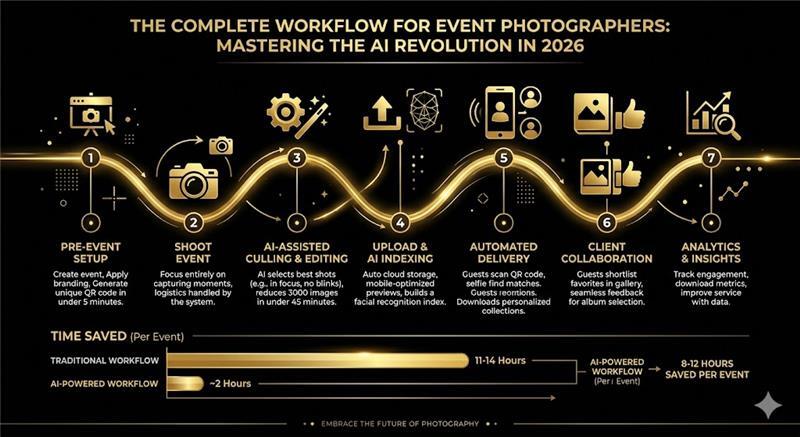
Master the complete AI-powered workflow for event photographers in 2026. From instant QR setup to automated delivery and analytics, learn how professionals save hours, streamline operations, and deliver a premium guest experience.
In the professional photography landscape of 2026, the industry has reached a definitive crossroads. We are no longer debating whether Artificial Intelligence has a place in our kits; we are witnessing a widening chasm between those who use it and those who are being left behind.
The gap between photographers who are thriving today and those who are struggling isn't necessarily a matter of raw talent or the price of their glass—it’s a matter of systems. The most successful event photographers have transitioned from being manual laborers of the digital darkroom to being "Creative Directors" of their own automated ecosystems.
By leveraging an end-to-end AI photo delivery system, modern pros are reclaiming hundreds of hours while providing a "magic-like" experience for guests. Here is the definitive 7-phase workflow for the high-performance event photographer in 2026.
Phase 1: Pre-Event Setup (The "Under 5 Minute" Foundation)
In the past, setting up a client gallery was a tedious task of manual folder creation and settings toggling. In 2026, this is a streamlined, administrative "sprint."
Create Your Event: Log into your dashboard (such as studio.cam-shot.com). By clicking "New Event," you input the essentials: name, date, and client details.
The Power of White-Labeling: This is where you solidify your brand. Apply your custom domain and branding themes instantly. This ensures that when a guest lands on the gallery, they see your brand, not a third-party hosting site.
The Proactive QR Strategy: Forget handing out business cards that end up in the trash. The system instantly generates a high-resolution QR code. Pro photographers now deploy these on digital event slides, printed table cards, and even the event backdrop.
Set and Forget: Configure your delivery settings—PIN protection, WhatsApp triggers, and face recognition—before you even pack your camera bag.
Phase 2: The Art of the Shoot
Because your delivery logistics are already "solved" in Phase 1, your mental bandwidth during the event is 100% dedicated to your craft. You aren't worrying about how you’ll get "that one shot" to "that one guest." You are free to hunt for candid emotions, perfect compositions, and the fleeting moments that make event photography an art form. In 2026, the photographer’s value lies in their eye, not their ability to manage a spreadsheet of email addresses.
Phase 3: AI-Assisted Culling & Editing
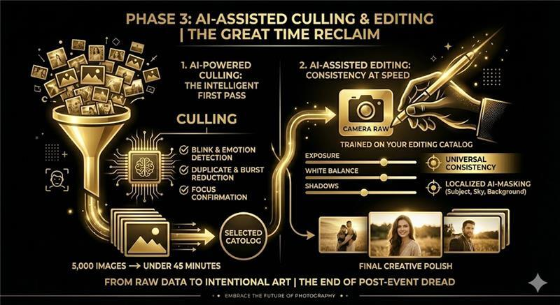
The "Post-Event Hangover" used to consist of staring at 3,000 RAW files with a sense of dread. No more.
Using sophisticated AI culling tools like Aftershoot or Lightroom AI, the mechanical triage of a shoot is handled in under 45 minutes. These tools automatically identify:
Out-of-focus shots.
Duplicate sequences.
"Blinkers" (subjects with eyes closed).
Sub-optimal compositions.
By reducing 3,000 images to the "Best 800" selects through AI, you aren't losing creative control—you are simply removing the noise. The AI handles the "triage," while you make the final "creative" decisions on the edit.
Phase 4: High-Speed Upload & AI Indexing
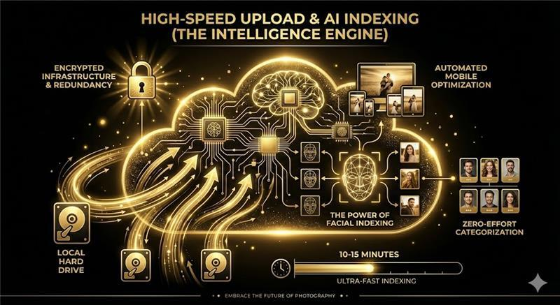
Once your edits are exported, the heavy lifting begins—but not for you. Dragging your photos into the Cam-Shot AI dashboard initiates a sophisticated chain reaction:
Encrypted Storage: Your original files are stored in secure, cloud-based infrastructure.
Mobile Optimization: The system automatically generates lightweight preview versions. In an era where 90% of event photos are viewed on smartphones, speed is the ultimate currency.
The Facial Index: This is the "secret sauce" of 2026. As you upload, the AI runs face detection, identifying every individual in every photo and building a searchable index.
For a standard 1,000-photo delivery, the entire indexing process takes about 10–15 minutes. This is "found time" that you can spend on marketing, rest, or your next booking.
Phase 5: The "Magic" of Automated Delivery
This is the phase where the ROI (Return on Investment) becomes visible to the client. We have moved past the era of the "General Gallery Link" where guests have to scroll through 800 photos to find three of themselves.
Instant Notification: Guests who pre-registered or scanned the QR code receive an automated WhatsApp or email the moment the gallery goes live.
The Selfie Search: Guests take a quick selfie within the web app.
Instant Photo Finder: The AI matches their face against the indexed gallery in seconds.
Personalized Collections: Each guest is presented with a curated selection of only the photos they appear in.
This frictionless experience eliminates the need for manual sends or individual WhatsApp messages, making you look like a tech-forward visionary in the eyes of your clients.
Phase 6: Frictionless Client Collaboration
For high-ticket events like weddings or corporate galas where a physical album is part of the package, the "Selection Phase" used to be a bottleneck.
Using Cam-Shot AI’s Photo Selection tool, the collaboration is handled entirely within the gallery. Clients can "like," comment, and shortlist their favorites. You can set specific selection limits (e.g., "Choose 50 photos for the album"), and once they are done, you export the list in a single click. No more cryptic emails describing "the photo of my aunt near the dessert table."
Phase 7: Data-Driven Analytics
In 2026, the most successful photographers are also the most informed. The final phase of the workflow involves reviewing the Analytics Dashboard.
Engagement Metrics: Which photos were downloaded the most?
Guest Activity: How many people actually used the QR code?
Marketing Insight: Use this data to prove your value to corporate sponsors or to refine your shooting style for future events. Understanding what "lands" with an audience allows you to offer a premium, data-backed service that justifies higher rates.