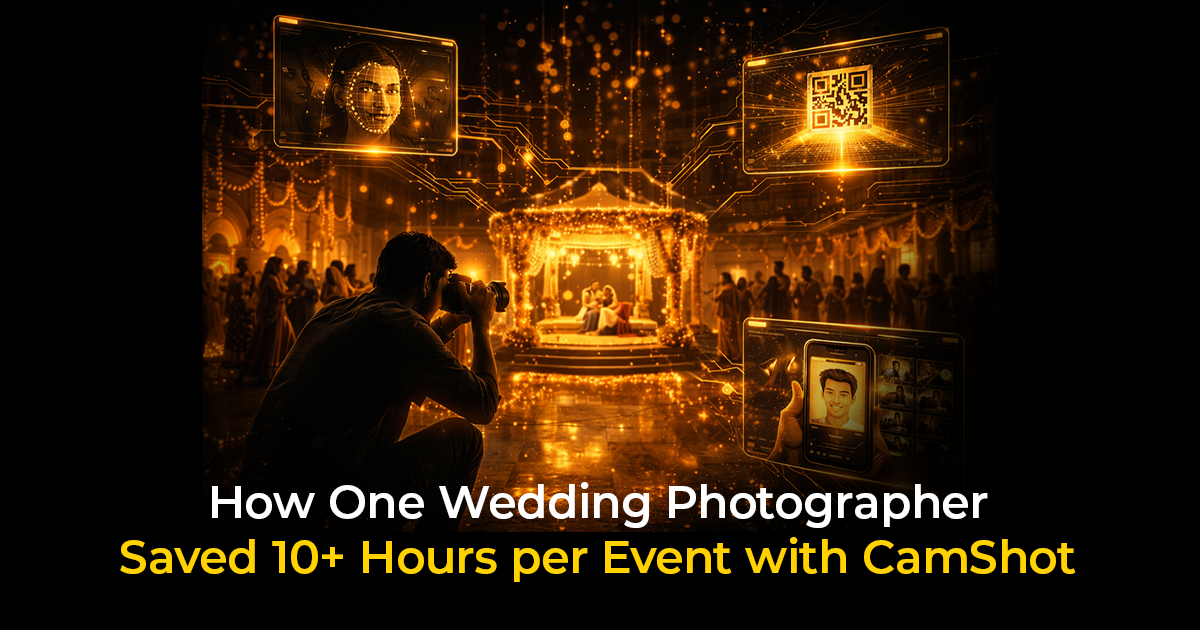
After years of drowning in WhatsApp photo requests, Rahul Sharma of Sharma Clicks transformed his wedding workflow with CamShot AI. From 13 hours of post-event chaos to under one hour, this is the story of how AI-powered galleries boosted referrals and revenue.
01 CLIENT SNAPSHOT
If you've ever attended an Indian wedding, you know the energy. The dhol beats, the marigold garlands, the hundred-and-one relatives in silk sarees and sherwanis, and the Chaos — beautiful, joyful, completely wonderful chaos — of a three-day celebration that starts with Mehendi and ends with tears at the Vidaai.
For Rahul Sharma, that chaos was his office. Eight years into his career as a wedding photographer in Jaipur, he had shot hundreds of shaadiyan — from intimate backyard ceremonies in Mansarovar to lavish palace weddings at Rambagh. He loved the work. Every event felt like a privilege.
What he did not love was the week that came after. Because after every wedding, without fail, came the wall of WhatsApp messages.
"Every Monday morning I'd open my phone and feel my stomach drop. Forty, fifty, sometimes a hundred messages. 'Bhaiya, meri photo?' 'Rahul ji, Sunita aunty ki koi photo aayi?' It felt like a second job — and not one I had signed up for."
— Rahul Sharma, Sharma Clicks, Jaipur
This is the story of how Rahul found CamShot AI, what happened the first time he used it at a wedding, and how — in three months — it changed not just his workflow, but his entire business.
The Hidden Cost of Every Indian Wedding
Most people think about photography in terms of the shoot itself. The golden hour portraits. The tears during the Vidaai. The wild dancing at the Sangeet. But the shoot is only half the job — and, for many photographers, the easier half.
For Rahul, a typical wedding with 600 guests and five ceremonies meant walking away with 4,000 to 5,000 raw images. Then came the real work.
- Manual culling through thousands of similar shots — 3 to 4 hours
- Colour grading and editing in Lightroom — another 4 to 5 hours spread over 2 days
- Exporting, compressing, and uploading to a shared Google Drive — 1 to 2 hours
- Sharing a single link with the couple and hoping they'd forward it to 600 guests
- Responding individually to every guest who couldn't find their photo — 2 or more hours, ongoing
The math was brutal. That's 10 to 13 hours of post-event work — on top of 12 to 16 hours of actual shooting. And it repeated every single week.
"I calculated once that I was spending more time on delivery than I was on actually shooting. I was charging for photography but doing the work of a server admin and a WhatsApp helpdesk."
— Rahul Sharma
The Moment That Broke the Camel's Back
It was the Gupta family wedding in December 2023. The bride, Neha Gupta, had 280 relatives flying in from Mumbai, Bengaluru, and even Dubai. The wedding spanned four days across two venues. Rahul shot over 5,200 photos.
Within 24 hours of the final ceremony, his phone had received 87 individual WhatsApp messages — relatives asking for specific photos, group selfies, candid shots. One message from the bride's mother, Kamla Gupta, simply read: 'Beta, 4 din hua, ek bhi photo nahi mili abhi tak.' (Son, 4 days have passed and not a single photo has arrived yet.)
That was the week Rahul started looking for a better way.

How Rahul Found CamShot AI
In February 2024, Rahul attended a photography workshop in Mumbai — one of those two-day affairs where photographers from across India gather to talk shop, share lighting techniques, and complain about difficult clients. He almost didn't go. 'I was so behind on deliveries, I nearly skipped it,' he remembers.
On the second day, during chai break, he got talking to Vikram Nair — a Bengaluru-based photographer who specialised in tech conferences and corporate events. Vikram mentioned, almost in passing, that he had recently switched to a platform called CamShot AI and cut his post-event time from 10 hours to under 45 minutes.
"I thought he was exaggerating. Photographers always exaggerate. But he showed me on his phone — a QR code, a selfie from a guest, and boom — 40 personalised photos appeared in seconds. I just sat there with my chai getting cold."
— Rahul Sharma
Vikram explained the core idea: CamShot AI uses face recognition to automatically index every person in a photo gallery. Guests scan a QR code, take a selfie, and the AI instantly shows them every photo they appear in — without any manual work from the photographer.
No sorting. No tagging. No forwarding individual photos on WhatsApp at 11pm.
Rahul signed up that evening from his hotel room at cam-shot.ai.
Testing CamShot on a Smaller Event First
Before trusting CamShot with a full wedding, Rahul tested it at a lower-stakes event: the 50th birthday celebration of Sunita Agarwal in Udaipur. It was an elegant garden party — 200 guests, two ceremonies, roughly 800 final photos. The kind of event where mistakes are forgivable.
He uploaded the photos to CamShot immediately after the shoot, while still driving back to Jaipur. The AI took roughly 18 minutes to scan and index all 800 faces across every photo. He generated the QR code, shared it in the birthday WhatsApp group, and went home.
"I woke up the next morning fully expecting a pile of problems. Instead, I had three messages — all of them compliments. Sunita ji's daughter Priya had already shared her personalised gallery on Instagram. I had zero requests. Zero. I actually checked if I'd sent the right link."
— Rahul Sharma
What struck Rahul most wasn't just the time saved — it was the guest experience. People who had never once messaged him after previous events were suddenly tagging him in Instagram stories. They felt seen in a way that a shared Google Drive link never made them feel.
He was hooked. He rolled CamShot out across every booking from that point forward.

A 600-Guest, 3-Day Jaipur Wedding with 4,800 Photos
The real proof came three months later. Deepika Kapoor and Rohit Singhania's wedding was everything Jaipur weddings are famous for — a heritage venue in the old city, 600 guests, traditional Rajasthani decor with marigold and mogra everywhere, and four full days of celebration.
Rahul and his two associate photographers shot 4,800 final images across the Mehendi, Haldi, Sangeet, Baraat, and Vidaai. In the old days, this would have consumed his entire week. He had once spent nine days delivering photos from a similarly scaled wedding.

This time, by 9 AM the morning after the Vidaai, all 4,800 photos were indexed and the QR code was live in the wedding's WhatsApp group.
- By noon, over 400 guests had already accessed their personal galleries
- Deepika's mother, Savita Kapoor, called Rahul personally — unprompted — to say it was the best photography experience she had ever seen
- The Sangeet video went viral on Instagram, with Rahul's studio tagged in over 80 posts
- Rahul received exactly four WhatsApp messages post-event — all of them saying thank you
"Hamari poori family shocked ho gayi thi. Everyone had their own photos ready on their phone within hours of the wedding ending. My grandmother in Jodhpur — she's 78, not so good with phones — even she could find her photos. Rahul bhaiya ne kamaal kar diya."
— Savita Kapoor, Mother of the Bride, Jaipur
What Changed for Rahul and Sharma Clicks
By November 2024 — three months after fully adopting CamShot AI — the numbers painted a clear picture. This wasn't just a workflow improvement. It was a business transformation.

Time Savings
The most immediate change was the 10+ hours reclaimed per event. Across 12 events in his first three months using CamShot, that was over 120 hours given back — the equivalent of three full working weeks. Rahul used that time to shoot more events, develop his editing style, and finally take a Sunday off.
The Referral Explosion
The more surprising result was what happened to his bookings. Because CamShot's personalised galleries were so shareable, every guest became a mini-ambassador for Sharma Clicks. When Priya Mehta shared her Kapoor-Singhania photos on Instagram with the caption 'Found all my photos in 30 seconds thanks to this QR magic,' Rahul got six inquiry messages that week from her followers.
His referral bookings — clients who came specifically because someone had shared their CamShot gallery — grew by 4x in three months. He raised his base package price by Rs. 8,000 and saw zero resistance. Clients were paying for the experience, not just the photos.
"Before CamShot, I was marketing myself through Instagram and paid ads. Now my best marketing is just guests finding their own photos and sharing them. Every wedding becomes a portfolio that walks around on 600 phones."
— Rahul Sharma
The Human Side of the Change
There's a number that doesn't show up on any dashboard, but Rahul considers it the most important result of all. His post-event anxiety — that Sunday evening dread of the coming week's WhatsApp flood — is gone.
'I used to tell my wife Meena that I need one day after every wedding just to mentally recover from the delivery stress,' he says. 'Now I come home after a shoot, upload on the drive back, and actually be present for dinner. That's worth more to me than any stat.'
Scale, WhatsApp Culture, and the Joy of Being Found
Indian weddings are unlike any event in the world. A shaadi is not one event — it's five. It's not one venue — it's often three. It's not 100 guests — it's 600, arriving from twelve different cities, each with their own phone and their own very particular desire to find the photo where they look good.
Traditional photo delivery simply cannot keep up. A single Google Drive link shared with 600 people results in mass overwhelm. WhatsApp requests are inevitable. The photographer becomes an unpaid photo-concierge for a week after every event.
CamShot AI was built for exactly this kind of scale. Its face recognition works reliably in the challenging conditions of Indian weddings — crowded dance floors, dim evening lighting at the Mehendi, bright afternoon sun during the Haldi, the beautiful chaos of the Baraat.
"The QR code fits perfectly into how Indian families already communicate. You just drop it into the wedding WhatsApp group — the one that already has 200 members — and it works. Even maami ji from Meerut figured it out in two minutes."
— Rahul Sharma
The self-serve nature of CamShot also fits something uniquely Indian: the wedding doesn't end when the Vidaai does. Families share photos for months. Aunties argue over who looked better in which ceremony. Grandparents in smaller towns show their friends on WhatsApp. CamShot's personalised galleries travel with every share — and Rahul's studio name travels with them.
Five Lessons from Rahul's Journey
Rahul's story isn't unique. Talk to any wedding photographer in Delhi, Chennai, Kolkata, or Hyderabad and you'll hear the same post-event frustrations. CamShot AI offers a practical, scalable path out of the workflow trap — here's what Rahul would tell a fellow photographer today:
- Start with one event — the time savings are visible immediately, even at smaller events
- Trust the AI — it handles Indian faces, Indian light conditions, and Indian wedding crowds reliably
- Use the QR code in the wedding WhatsApp group — adoption is instant because the behaviour is familiar
- Raise your prices — the guest experience CamShot creates genuinely justifies a premium
- Watch your referrals — the marketing value of shareable personalised galleries compounds over time
"I wish I had found CamShot three years earlier. I would have had more time, less stress, and a bigger business. But the second-best time to start is now — and I tell every photographer I meet to just try it once."
— Rahul Sharma, Sharma Clicks
Ready to Transform Your Photography Workflow?
Join thousands of photographers across India using CamShot AI to save time, delight guests, and grow their referral business.
👉 Visit www.cam-shot.ai to get started today — free